Monday, February 23, 2015

Investing Performance for 2014 - ALN, GPRC, SKBI, BH


The year 2014 will be remembered as the let-down year for my performance. It was the type of year where I was patiently sitting and waiting for the intrinsic value of the undervalued companies in my portfolio that have attractive growth characteristics to be realized by other investors. It did not happen but this is only a test of my patience.

At the time of this writing as well as at the end of the year American Lorain Corporation represented slightly over 50% of the whole portfolio. Just to recap, here is an excerpt from last year's letter on why I am so heavily invested in Chinese Reverse Merger companies.


At the end of 2010, an accounting scandal of incredible proportions was affecting the sphere of Chinese reverse merger companies. Investors were relentlessly dumping their share holdings on the market and all companies related to china saw their share prices prices fall over 70%. 

ALN is one of the falling knifes I was able to catch right. Let's hope I did it before it hit the ground. At the time of writing this article on 23/02/2015 after market close, the company's stock has already returned over 32% year to date. I am convinced that more impressive gain s still remain to be harvested over the next two years.

There are also a few blunders to mention. Guanwei Recycling Corp. is one of the reverse mergers that burned me for the year. If it was not for that company, my performance for the year would have hovered around 0% for the year. This would have been acceptable considering that ALN, my main position, is still consolidating.

Biglari Holdings Inc, formerly know as (Steak n Shake) is the new addition for the year. A small position was opened just to follow and understand what the company's Chairman, CEO and biggest shareholder, Sardar Biglari is trying to build over time.

Here are my positions for the year:

Long:

Taking those positions into account, my performance in 2014 was a disappointing -16.2%, and the S&P/TSX did 7.4%, so it makes it that I under-performed it by 23.6%. This is very in line with that I should expect with my level of experience in that market. Last years performance was likely due to chance and it is very improbable that I will be able to replicate it in the future.


Previous Years Performance:
2013
2010
2008

Monday, May 26, 2014

Buying Google Inc. (GOOG, GOOGL) for the next 5 years?

As 2014 marks the 10th anniversary of Google Inc's IPO, let's take a look at what the company has delivered so far and see what the stock might have for investors in the next 5 years.

For those unfamiliar with the company, more information can be found on their investors relations webpage.


Google Inc . Logo


Here is a brief description provided by Reuters:
Google Inc. (Google), incorporated on October 22, 2002, is a global technology company. The Company’s business is primarily focused around key areas, such as search, advertising, operating systems and platforms, enterprise and hardware products. The Company generates revenue primarily by delivering online advertising. The Company also generates revenues from Motorola by selling hardware products. The Company provides its products and services in more than 100 languages and in more than 50 countries, regions, and territories. 

Considering the stocks lowest P/E ratio over the past 5 years of 21.73, the present price of the stock assumes that the earnings of Google Inc. will grow by roughly 5.8% over the next 5 years, giving us a 2019 price of $552. However, public information tells us that earnings have been growing at and annual rate of 61% over the past 10 years and 26% a year over the past 5 years. Using a more realistic number of 24%, the company is now worth $1,256 per share for a 5 year holding period.

That is a more extreme example but using 4 different valuation methods and relatively conservative assumptions regarding the future growth of the earnings of the company, we got an average price of $847 per share.


The two models that are based on the earnings tend to provide a higher estimate than the ones based solely on free cash flows. This point might prove to be a cause for concern in the long term. Even if it's not a screaming Buy, the company however seems to present a discount based on it's current price. Only time will tell which valuations method is right.


Disclosure: The author has no position in GOOG or GOOGL.


How much do you think Google Inc. is worth?

Wednesday, May 7, 2014

Ridley Inc: Why Value Investing Requires Patience RCL.TO FFH

Back in 2010, I made a quick showcase about an obscure canadian company that was purchased by FairFax Financial Holdings called Ridley Inc.

The stock has experience a huge surge since then but unfortunately I sold for very short term gains after the share price climbed from $7 to $10. Now it stands at an astonishing $25.89 after market close on May 7th 2014 as can be seen on the chart below. On top of it all the company paid $5.5 in dividends over the same period.


Did you miss out on it as well?

Sunday, April 27, 2014

The Going Concern Value of Herbalife (HLF)

For active participants in the financial markets, the saga of events surrounding Herbalife Ltd. (HLF) since the end of 2012 has been quite a rollercoaster ride. Small investors involved with the stock have been drawn to pick a side in an epic battle opposing on one side legendary investor Carl Icahn of Icahn Associates Corporation and on the other side hedge fund manager Bill Ackman of Pershing Square Capital Management.

For those unfamiliar with the company, it's description can be found here on Reuters website:
Herbalife Ltd., incorporated on April 04, 2002, is a global nutrition company. The Company sells weight management, healthy meals and snacks, sports and fitness, energy and targeted nutritional products as well as personal care products. It distributes and sells its products through a network of independent distributors, using the direct selling channel. The Company categorizes its science-based products into four principal groups: weight management, targeted nutrition, energy, sports & fitness and Outer Nutrition.
As of December 31, 2012, it sold its products in 88 countries to and through a network of approximately 3.2 million independent distributors. In China, in order to comply with local laws and regulations, it sells its products through, sales representatives, sales officers, independent service providers and in retail stores. On December 31, 2012, the Company acquired a manufacturing facility in Winston-Salem, North Carolina. The Company’s operating segments are based on geographical operations in six regions: North America, Mexico, South & Central America, EMEA (Europe, Middle East and Africa), Asia Pacific and China. As of December 31, 2012, we marketed and sold 140 products encompassing over 4,900 stock keeping units (SKUs).

For my part, I have been tempted to take Bill Ackman's side by taking a short position in medium term out of the money options after going through the Pershing Square presentations. Even if the stock has not moved so much, I am betting on an increase in volatility as investors fight to determine who is right or wrong. To estimate the downside risk of my position I conducted a fundamental analysis of the company in order to put myself in the shoes of investors like Carl Icahn who are on the long side of Herbalife Ltd and here are the findings.

Considering the current P/E ratio of 11.74, the present price of the stock assumes that the earnings of Herbalife Ltd. will grow by roughly 5% over the next 5 years, giving us a 2017 price of $. However, public information tells us that earnings have been growing at a little over 30.5% a year over the past 10 years. 

Using a rate of 2/3 of the recent years growth of about 20% we find ourselves with a 2017 price of 132$ per share with a P/E Ratio of 8.36, the lowest it has been over the last 5 years for the company. The earnings trend of the past 10 years can be seen here:


Also, Herbalife has managed to grow it's book value per share over the past 10 years at an average rate of slightly over 8% per year. Assuming the pace slows down to 5%, once again 2/3 of the 8.8% 10 year average, we end up with a book value of nearly 7.60$ per share in 2019. The current P/B Ratio stands at 10.6 so assuming it's stays flat, we get a stock price of 81$ in 2019. Here is how EPS and Book Value per Share have evolved over the past 10 years:


The previously raised assumptions are very optimistic, it seems at a first glance that the market has a biased bearish view on the long term prospects of Herbalife. The data displayed shows that Herbalife is undervalued based on fundamental grounds. The only drawback of this narrow point of view if that even if the company looks cheap, it doesn't keep the business model from being called into question. In time, the results of the investigations by the FTC and the FBI will confirm if the company stays in business or not. In the meantime, the stock of Herbalife Ltd. will keep behaving like a binary option, displaying high volatility until the allegations are invalidated or confirmed. This shall be beneficial for out of the money options until then.

If you chose a long position with Carl Icahn on this trade, the stock of Herbalife Ltd. will be worth somewhere between $81 and $142 by 2019, providing a 7% to 20% compounded annual return to investors. If you decide to side on a short position with Bill Ackman, the stock is going to 0$ as the company gets shut down by regulators.


Which side did you pick?


Disclosure: The author has a short position in HLF.

Friday, January 17, 2014

Investing Performance for 2013


2013 can be described as the year of the comeback after two very lean and very poor years, it is mostly due to the high concentration of almost 30% of my holdings in one specific company. It is also a year when I decided to get back to the basics, finding undervalued companies that have attractive growth characteristics.

As I look back at the year, the broad rally experienced by stocks in 2013 is fundamentally attributable to the quantitative easing measures by the Federal Reserve in the US and a slight improvement of the global economic environment.

My biggest position was certainly Skystar Bio-Pharmaceutical Company. At the end of 2010, an accounting scandal of incredible proportions was affecting the sphere of chinese reverse merger companies. Investors were relentlessly dumping their share holdings on the market and all companies related to china saw their share prices prices fall over 70%. I was lucky enough to have found this falling knife right before it hit the ground. Nothing much happened until the end of August when the stock started posting incredible gains. I decided that taking some profits off the able was warranted and sold 75% of my position on October 10th 2013 after the stock had gained over 200% for the year. This proved to be a wise decision because prices came back down to more reasonable levels.

There are also a few blunders to mention. As the price of gold was rising and mounting fears of inflation, I decided to take a long position in shares of Osisko Mining Corp, this proved to be a poor decision because gold prices have only kept coming down since then. Even the recent opportunistic bid by Goldcorp does nothing to get the price back up to my original entry price.

Here are my positions for the year:

Long:

Taking those positions into account, my performance in 2013 was an incredible 114.4%, and the S&P/TSX did 9.6%, so it makes it that I over-performed it by 104.8%. This is very encouraging but I remain cautious, this performance might be due a great deal to chance and it is very improbable that I will be able to replicate it in the future. The downside is that even if I showcased a better performance than this index, it will get harder in the coming year to find such attractive opportunities and repeat a relative performance of this magnitude.


Friday, September 27, 2013

SKBI Is Inching Closer to Fair Value

As expected, the market is slowly starting to recognize the true value of SKBI. The details of the calculation of the true value of the company can be found in this previous article:

What has happened over the past couple of weeks had been a gradual adjustment of the P/E ratio of the company by investors to bring it more in line with the rest of the industry.

From now on the real treats will start after every quarterly release. After each of them, the company will announce that more of their factories are operational. 

The biggest kicker will happen when the vaccines factory start producing as well.

 As seen in their previous earning releases  vaccines have the highest operating margin among all the products manufactured by the company.

Since I published my analysis on the company, the stock went down. It has recently come back with a vengeance and is up over 100% since the April 2012 recommendation. As you can see in the table below, the stock still has a lot of room for growth in the future.


Feel free to let me know what you think about SKBI.

Disclosure: The author has a long position in SKBI.

Tuesday, October 16, 2012

To the Board Of American Lorain Corp: Reject The CEO's Offer


Back in April 2012, I wrote an article about what I thought was an estimate of the value of American Lorain Corp. (ALN) , the initial results were for a range going from 8.44$ to as high as 32.53$. Since then I revised down my estimate of the value of the company and I will elaborate on this point later.
First, let's examine some worrying facts. On October 15th Mr. Si Chen, chairman and CEO of American Lorain Corp submitted "a preliminary, non-binding proposal letter", in which he publicized his intention "to acquire all of the outstanding ordinary shares of the Company not currently owned by Mr. Chen at a proposed price of $1.6 per ordinary share, in cash, subject to certain conditions. Mr. Chen currently beneficially owns, in the aggregate, approximately 46.5% of the Company's outstanding ordinary shares."
A very disturbing fact about this proposal is that the independent committee that has been set up to analyze it, composed of Mr. Dekai Yin, Mr. Tad M. Ballantyne and Mr. Maoquan Wei; Mr. Yin as its chairman, is far from independent. In fact the independent committee held no shares in the company as of their last Form 3 filings according to the SEC, how can they related to the other shareholders of the company who have no influence on the company?
For the shareholders who have not read it, the official proposal letter can be found here. The Board will have to enter a delicate exercise to make sure they extract fair value for the remaining shareholders and that they do not unfairly disadvantage the shareholders other than Mr. Chen.
Using pretty much the same format used in my previous article, let's see how much this offer is ridiculously low compared to the current intrinsic value of American Lorain Corp.
Assuming the current P/E ratio of 2.31, the current price assumes that the undiscounted earnings of American Lorain will grow by a little over 3% over the next 5 years, giving us a 2017 price of 1.60$, so the assumed figure of the CEO's proposal is actually lower. Public information tells us that earnings have been growing at about 24.8% a year over the past 7 years. Let's make another assumption that American Lorain is only able to grow EPS at 10% per annum. We find ourselves with a 2017 price of 2.35$ per share with the current P/E ratio. According to Reuters, the industry's average P/E stands at 34, but even with a ratio of 10 in 2017, American Lorain would be worth around 10$ per share.
From another standpoint, American Lorain has managed to grow its book value per share over the past 7 years at an average rate of 35% per year. Assuming the pace slows down to 20% as the company gets bigger, we end up with a book value of 13.58$ per share in 2017. If we use the current incredibly depressed Price/Book ratio of 0.26, we end up with a price per share of 3.53$. If we compare once again to the industry, we see that the average Price/Book ratio is close to 5. Using an alarmingly conservative Price/Book ratio of 1 for the year 2017, we obtain a value of 28$ per share.
Finally, as of June 30th 2012, the book value of the company amounted to 4.79$ per share, which is a 245% premium over the closing price as of October 15th 2012, or a 316% premium over the referenced October 8th closing price. The Board therefore should categorically reject the offer. Accepting the offer would be a blatant case of conflict of interest and negligence of the right of shareholders that are not insiders. Mr. Chen must have insulting levels of chutzpah to try to acquire a company he knows currently incredibly undervalued.
(click to enlarge)
In my opinion, if they intend to accept the offer, the Board could still give at most a 30% discount to Mr. Chen and offer shareholders a meager 3.35$ per share, this would be less insolent. His attempt is clearly an insult to the intelligence of the company's shareholders. I still err on the side of the book value of the company as a starting offer to shareholders.
Disclosure: I am long ALN. I wrote this article myself, and it expresses my own opinions. I am not receiving compensation for it (other than from Seeking Alpha). I have no business relationship with any company whose stock is mentioned in this article.

Monday, September 3, 2012

The Fed Is Growing the US Money Supply, So What?

As speculation grows surrounding the upcoming September 13th 2012 Fed meeting and whether or not there will be another round of quantitative easing to boost the economy, it is interesting to stop for a moment and examine how the M1 money supply has evolved over the past 30 years.

This chart provided by the St. Louis Fed gives a good glimpse at how the M1 money supply has evolved in the recent decades. It simply shows the money stock at the end of each month since August 20th 1982 in billions of dollars.


As they say, a picture is worth a thousand words and I thought it would be interesting to have a visual representation of how far we have come since the 2007 financial crisis. The last two rounds of quantitative easing have almost doubled the M1 money supply in as little as 4 years. One only has to wonder what will be the long term effect of going from 1.4 trillion to 2.4 trillion USD on the dollar. Even if it is currently the world reserve currency, it is obvious the US Dollar is bound loose value in the coming years. How is your portfolio positioned assuming such a scenario? Soon enough the world will notice that they are getting less and less value for their US Dallar holdings. Food for tought....

Monday, July 2, 2012

China Ceramics Co Ltd. (NASDAQ:CCCL); Taking Advantage of the Chinese Real Estate Boom

Following in the recent series of fantastic chinese companies, a new comer has been suggested by Omit Majumdar, a colleague of mine. The company has surged as an interesting opportunity for investors who want to position themselves to take advantage the prevailing economic environment in China.

As the construction boom beats relentlessly because of increased demand, the chinese consumers are looking to own home more akin to those available to the western countries. This is proving to be a great bonanza for companies involved in the construction business. Many chinese companies listed on US stock exchanges are still plague by the financial reporting scandals and are currently trading at multiples to their fundamentals low enough to make investors pant like Pavlov's dog.

As per Reuters, China Ceramics Co., Ltd. (China Ceramics), incorporated on June 22, 2007, is a manufacturer of ceramic tiles. These ceramic tiles are used for exterior siding and for interior flooring and design in residential and commercial buildings. The ceramic tiles, sold under the Hengda (HD), Hengdeli (HDL), TOERTO and WULIQIAO brands are available in over two thousand styles, colors and size combinations. China Ceramics has six principal product categories: porcelain tiles, glazed tiles, glazed porcelain tiles, rustic tiles, ultra-thin tiles and polished glazed tiles. Porcelain tiles are the Company’s major products and accounted for over 68.4% % of its total revenue during the year ended December 31, 2011. Ceramic tiles are used in the People's Republic of China (PRC) as a construction material for residential and commercial buildings. Ceramic tiles are used for flooring, interior walls for decorative purposes and on exterior siding.
China Ceramics manufacturing facilities operated as Jinjiang Hengda Ceramics Co., Ltd. are located in Jinjiang, Fujian Province, and its manufacturing facilities operated as Jiangxi Hengdali Ceramic Materials Co., Ltd. are located in Gaoan, Jiangxi Province. As of December 31, 2011, these facilities provided an aggregate annual production capacity of approximately 52 million square meters. As of December 31, 2011, the Company had twelve production lines. The Company primarily sells its products through a distributor network or directly to property developers.

The most recent financial data shows that the company has grown it's earnings from RMB 101M in 2006 to RMB 294M as of FY 2011. This is tremendous growth for a company operating in a real estate market that is showing anything but signs of slowing down while having little cues of overheating like we are currently experiencing in North America.

If we look at the historical performance of the company from a US perspective, it is obvious that the company is growing at a fast pace. The current trend also tells us that earnings will still be impressive even if the company does not grow as the chinese RMB will continue to appreciate compared to the USD in the foreseeable future. The company has a big free cash flow problem because it is aggressively reinvesting in it's growth, but other fundamentals of the company show that as soon as chinese companies start being valued adequately by the market it shall offer an interesting return for it's shareholders at current prices.


Disclosure: The Author is Long CCCL


Monday, June 18, 2012

Wood Composite Technologies Inc: The Last Cigar-Butt Company?

When Warren buffett started his partnership, he used to for cigar-butt companies. By that meaning, as Benjamin Graham tried to find before him, firms that were not very popular but still had one last puff of earnings or value to give to shareholders and that offered themselves at a valuation attractive enough to make them seem almost free.

It seems it is still possible to find companies with such caracteristics. Just looking at the latest quarterly filing will make you wonder why there are not more people jumping at this company.


According to Reuters, Wood Composite Technologies Inc. develops, manufactures and sells composite decking products. The Company’s products include decking boards and a variety of decking trims and fascia suitable for residential and commercial decking and dock purposes, which were manufactured on site in Nisku, Alberta. The Company markets these products throughout Canada and the United States to retail consumers and building contractors through various building supply dealers and wholesalers. It distributes the product in Canada under the brand name of Millennium Decking Inc., its wholly owned subsidiary while Millennium Decking (USA) Inc. acts as its marketing entity in the United States.


The first point of interest here is that the company is trading under cash on hand per share. Indeed as of the last quarterly filing dated may 24th 2012 of the company has 3.7 Millions CAD in cash on hand.

Another interesting fact here is that the company also has 17 millions CAD of carried forward unused losses that are set to expire in the next five years. This is very attractive for a company willing to by them for that pursposes only, without even considering the current cash hoard. At the minimum 15% marginal tax rate available for Canadian corporations, this represents about CAD 2.6 Million in cumulative potential savings from the point of view of a company willing the bid on the company.

With 74,205,825 shares outstanding, we can establish two different values for the firm. One that just considers a liquidation and distribution of the company's cash in the form of a liquidating dividend. This would value the company at 0.048$ per share. Another way to value the company would take the perspective of an acquirer looking for a way to save on taxes in the future. From such a perspective, the company would be worth at most 0.083$ per share.

As of June 15th 2012, the shares traded at an ask price of 0.03$ per share. An investor positioning himself today has the potential to realize a profit ranging 60% in the case of a liquidation to 177% in the case of an acquisition, which will certainly materialize over the next year. With most investments providing meaningless risk-free returns, it will be beneficial for current and potential shareholders to press the company to realize the full value of the company on the August 7th Shareholders meeting as it has completely stopped it's operating activities with the recent sale of it's Nisku plant.


Disclosure: The Author is Long WCT.V

Monday, April 23, 2012

American Lorain Corporation (NYSE: ALN), a Global Exporter

In our quest to find undervalued companies, the Chinese reverse merger sector currently offers a lot of opportunities that can be hardly overlooked. We recently covered Skystar Bio-pharmaceutical Company (SKBI) and it seems that at least another company offers the kind of value that we are looking for.

According to Reuters, American Lorain Corporation (ALN), incorporated on February 4, 1986, is an integrated food manufacturing company. It develops, manufactures and sells food products, which include chestnut products, convenience foods, including ready-to-cook (RTC), foods, ready-to-eat (RTE), foods and meals ready-to-eat (MRE). ALN conducts its production activities in China. ALN operates under three segments: chestnut products, convenience food products, and frozen food products. During the year ended December 31, 2009, it produced 230 products, including 19 new products in its convenience foods segment. Its products are sold in 26 provinces and administrative regions in China and 42 foreign countries. Its subsidiaries include International Lorain Holding, Inc. (ILH), Luotian Green Foodstuff Co., Ltd. and Junan Hongrun Foodstuff Co., Ltd. The company operates in the following categories:

Chestnut Products
ALN developed brand equity for its chestnut products in China, Japan and South Korea. The chestnuts produced include aerated open-bottom chestnuts, which are chestnuts packaged with nitrogen; sweetheart chestnuts, which are sweet preserved chestnuts; chestnuts in syrup, and golden chestnut kernels. They are natural and do not contain chemical additives. The chestnut contains small quantities of oil and complex carbohydrates. Chestnuts are commonly steamed, boiled, sugar stir-fried, roasted or added into dishes or desserts as an ingredient. ALN differentiates its chestnut products based on flavor, size and method of packaging. The chestnut products that are sold in Japan are packaged in plastic bags or tin cans, each considered a different product. Some of its chestnut products are processed with hot water or cold water. The Company competes with Hebei Liyun and Foodwell Corporation.

Convenience Foods
ALN’s convenience food products are characterized as Ready-to-cook, or RTC, food products, Ready-to-eat, or RTE, food products, and Meals ready-to-eat, or MRE, food products. RTCs can be served after a few easy cooking procedures. When preparing a RTC, customers need only to heat the food in a microwave or boil it for several minutes before eating. RTEs can be served without any cooking. It includes various pickle products. Other RTEs include spiced belt fish, cherry tomato, spicy pork fillet, pork and egg roll, pears and pineapples. MREs are meal kits with self-heating devices. These are used in both military and civilian uses, such as camping, traveling and other situations, in which a person does not have access to traditional cooking supplies and equipment, such as a stove or microwave. During 2009, ALN also introduced MRE products that are microwaveable. MREs are based on various styles of food, such as Italian cuisine and Chinese cuisine. During 2009, ALN produced 117 convenience food products, including 16 new products, such as candied bean products and MRE microwaveable rice products.

Frozen Food Products
ALN produces a variety of frozen foods, including frozen vegetables, frozen fruits, frozen fish, and frozen meats. During 2009, it produced 61 frozen food products. The frozen foods sold during 2009 were frozen asparagus and frozen corn. During 2009, this segment contributed 15.7% of its total revenues. The Company competes with Weitang Langdong, Yuyao Hongji Food Co. Ltd. and Yantai Pengshun Food Co. Ltd.

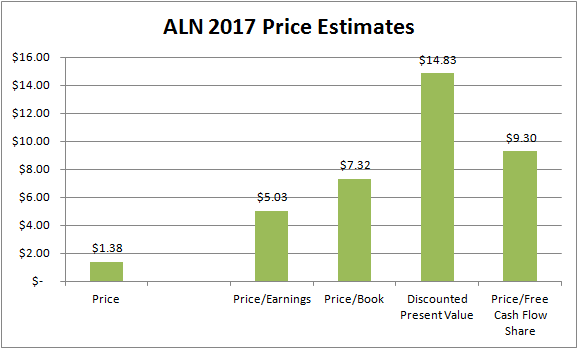
Let's take a loot at the fundamentals for the company. Assuming the current P/E ratio of 2.3, the current price assumes that the earnings of American Lorain will remain flat over the next 5 years, giving us a 2017 price of 1.33$. However, public information tells us that earnings have been growing at about 25% a year over the past 7 years. Let's make another assumption and let's say that the current inflationary environment puts some breaks on the growth of Lorain's earnings and that the company is only able to grow EPS at 10% per annum. We find ourselves with a 2017 price of 2.35$ per share with the current P/E ratio. The industry's average P/E stands at 39, but even with a ratio of 10 in 2017, American Lorain would be worth around 21$ per share. The past performance of the company can be seen here:


Also, American Lorain has managed to grow it's book value per share over the past 6 years at an average rate of 35% per year. Assuming the pace slows down to 24% as the company gets bigger, we end up with a book value of nearly 16$ per share in 2017. If we use the current incredibly depressed Price/Book ratio of 0.29, we end up with a price per share of 4.76$. If we compare once again to the industry, we see that the average Price/Book ratio is close to 8. Using an alarmingly conservative Price/Book ratio for the year 2017, we obtain a value of 32$

The following table shows the relatively conservative 2017 price targets using different methods, even some that were not explored in details here:


Taking into account that the previously raised assumptions are not too optimistic, it seems to therefore that the market has a biased bearish view on the long term prospects of American Lorain Corporation, mostly compared to companies doing business in the same industry. The buying opportunity screams very loudly in this case and cannot be ignored. Investors getting in right now have a pretty wide margin of safety in case the company's operations would come to disappoint in the inflationary context currently prevailing in China. 


Disclosure: The author has a long position in ALN.

Monday, April 2, 2012

Skystar Bio-Pharmaceutical Company (SKBI), the Hidden Chinese Pharmaceutical

Not too long ago, roughly at the end of 2011, there was a breakout of a huge controversy surrounding dozens of chinese companies that accessed the US capital markets with reverse mergers, effectively getting an IPO through the backdoor. These companies we being critisized for misrepresenting their financial information, some cases falling into the downright fraud category.

According to the company's website, Skystar Bio-pharmaceutical Company ("Skystar") is one of China's leading manufacturers and distributors of vaccines and medicines for poultry, livestock and domestic pets. Skystar has over 173 products in its current product line and has over 50 more products in development. Skystar employs over 200 people in Production Facilities located in Hu Xian, Xi'an City, Shaanxi, Province, PRC.

Skystar has opened its GMP Certified Facility that increased production capabilities by 200%. The demand for veterinary medicines and vaccines in China far exceeds the supply and Skystar's plan is to capitalize on its new GMP Certified Facility to increase margins while increasing production to help meet the growing and overwhelming demand for its products.

Skystar has an experienced management team, a solid and diverse customer base, proven products, key R & D relationships to develop new products that are in high demand.

Skystar was incorporated on July 3, 1997 in the PRC as a limited liability company without shares. On December 31, 2003, Skystar was restructured from a limited liability company without shares to a joint stock company limited by shares. Skystar is a high-tech enterprise, which has grown to become one of China's leading manufacturers and distributors of bio-pharmaceutical and veterinary products. Skystar Bio-Pharmaceutical (Cayman) Holdings Co., Ltd. was incorporated under the laws of the Cayman Islands on January 24, 2005. The Company is engaged in the research, development, production, marketing and sale of bio-pharmaceutical and veterinary products. All current operations of the Company are in the People's Republic of China ("China" or the "PRC"). Skystar does not conduct any substantive operations of its own and conducts its primary business operations through its variable interest entity ("VIE"), Xian Tianxing Bio-Pharmaceutical Co., Ltd. ("Xian Tianxin"). In 2005, Skystar executed a Share Exchange Agreement with the Cyber Group Network Corporation ("CGPN"), which is listed on the NASDAQ, and then Skystar was restructured into Skystar Bio-pharmaceutical Company ("Skystar" or the "Company") (Nasdaq: SKBI)
Time will tell if the company has really cooked it's books, but in the meantime, I adhere to a contrarian camp who thinks that Skystar has room for tremendous growth. Assuming a the current P/E ratio of 1.5, the current price assumes a decrease of Skystar's earnings of 1.02% annually over the next 5 years, giving us a 2017 price of 2.70$!! However, we know that the chinese firm has been growing earnings at about 38% a year over the past 6 years. Let's make another assumption and let's say that the highly puts some breaks on the growth of Skystar's earnings and that the company is only able to grow EPS at 10% per annum. We find ourselves with a 2017 price of 5.07$ per share.

For the long term investor who is knowledgeable of the pharmaceutical industry in regards to farm animals, this must be a great entry price, from a fundamental sandpoint, into a company that is operating in an growing industry as china industrializes further. With my limited knowledge of this particular industry, I used four different measurements and I came to the conclusion that the current price of Skystar's stock is overly pessimistic. The P/E method, which would be set at 7, gave me a 31.36$ price tag on shares of SKBI.

From another point of view, Skystar has managed to grow it's book value per share over the past 6 years at an incredible 70% per year. Assuming they can manage to keep that pace, we end up with a book value of nearly 23$ per share in 2017. At the current depressed Price/Book ratio of 1.6, we end up with a price per share of 38$.
We can also look at free cash flow per share, which I calculated to have grown about 7% per year over the same period, even if it has been swigging wildly as it can be seen on the above chart. Keeping Skystar's stock for 5 years and using a 10% discount rate, I ended up with a present value of 23.40$ per share for SKBI. Free cash flow per share would end up being about 2.40$ per share in 2017, If we use a reasonable Price/Free cash flow ratio of 7, justified by the fact that the market will gradually realize the value of chinese companies, we end up with a 2017 price per share of 31.36$ per share.

Assuming that my assumptions are not too flawed, it seems to me therefore that the market is being overly bearish on the long term prospects of Skystar. Investors with a long term view will be rewarded with above average returns by holding their positions in the company.


Disclosure: The author has a long position in SKBI.

Wednesday, September 28, 2011

TreeHouse Foods Inc. (NYSE: THS) Q4 2011 Price Target


Recent price: 66.06$
P/E Ratio: 26.08
3 Months Target Price: 48$

Company Description
According to Reuters, TreeHouse Foods, Inc. (TreeHouse) is a food manufacturer servicing primarily the retail grocery and foodservice distribution channels. The Company’s products include non-dairy powdered coffee creamers, private label soups, salad dressings and sauces, sugar free drink mixes, hot cereals, macaroni and cheese, skillet dinners, Mexican sauces, jams and pie fillings, pickles and related products, infant feeding products, aseptic sauces, refrigerated salad dressings, and liquid non-dairy creamer. TreeHouse operates in three segments: North American Retail Grocery, Food Away From Home, and Industrial and Export. On March 2, 2010, the Company acquired Sturm Foods, Inc. (Sturm), a manufacturer of hot cereals and powdered drink mixes. On October 28, 2010, it acquired S.T. Specialty Foods, Inc. (S.T. Foods), a manufacturer of macaroni and cheese and skillet dinners.


Confidence Margins
Strong resistance $66.03 (-7%)
Light resistance $62.55 (-1%)
Light support $50.02 (+19%)
Strong support $46.73 (+25%)

Recommendation
This company is incredibly overvalued compare to it's more successful peers. Such high levels of valuation, even considering improving fundamentals, cannot justify multiples that are so far away from the industry. TreeHouse Foods Inc will be subject to a correction in the coming quarter.

Entry strategy
For the cautious investor:
Sell short the stock for 65$ or more.

For the risk-taking trader:
The November 2011 50$ out-of-the-money put option contract seems to be the right position to take, they can be acquired for about 55$ per contract.

Exit Strategy
For the cautious investor:
Buy to cover when the stock reaches 48$, or keep it until 46$ if you are more bearish in your own analysis.

For the risk-taking trader:
The contracts should be kept until the underlying reaches 48$. This should provide a good return if the underlying reaches the target price as the contracts will get deep in the money.

DryShips Inc (NASDAQ: DRYS) Q4 2011 Price Target


Recent price: 2.64$
P/E Ratio: 4.16
3 Months Target Price: 5$

Company Description
According to their SEC Filings, DryShips Inc. (DryShips) is a holding company. The Company is engaged in the ocean transportation services of drybulk cargoes and crude oil worldwide through the ownership and operation of drybulk carrier vessels and oil tankers and offshore drilling services through the ownership and operation of ultra-deepwater drilling units. As of April 12, 2011, the Company owned, through its subsidiaries, a fleet of 35 drybulk carriers comprised of seven Capesize, 26 Panamax and two Supramax vessels, which has a combined deadweight tonnage (dwt) of approximately 3.2 million dwt, and had contracts for two Panamax newbuilding drybulk carriers of 76,000 dwt. In May 2010, DryShips agreed to acquire a Panamax vessel, the MV Amalfi (ex Gemini S), which was delivered to the Company in August 2010, and agreed to sell one of its Panamax vessels, the MV Xanadu. In addition, it sold its Panamax vessel, the MV Primera. In August 2011, the Company acquired majority of OceanFreight Inc.


Confidence Margins
Strong resistance $7.11 (+135%)
Light resistance $4.95 (+31%)
Light support $2.52 (-5%)
Strong support $2.11 (-20%)

Recommendation
DryShips is a company that has it's stock subject to a lot of volatility. It however presents an impressive buying opportunity at current price, it is cheaper than on our last analysis. First, profitability is coming back to the company even if capital expenditures are rapidly increasing. The spin-off of the Ocean Rig subsidiary has partially materialized but it will greatly increase shareholder value while reducing the debt load of the holding company.

Entry strategy
For the cautious investor:
Buy the stock for 3$ or less.

For the risk-taking trader:
The January 2011 5$ out-of-the-money call option contract seems to be the right position to take, they can be acquired for about 10$ per contract.

Exit Strategy
For the cautious investor:
Sell when the stock reaches 5$, or keep it until 7$ if you are more bullish in your own analysis.

For the risk-taking trader:
The contracts should be kept until the underlying reaches 5$. This should provide a very interesting return if the underlying reaches the target price as the contracts will get in the money.